The truth exposed about one large-scale breeder in Wisconsin
Click Here to read about a television expose, aired April 26th, including footage of Puppy Haven.By Kelli Ohrtman: Best Friends NetworkPet stores around the United States sell approximately 3,000 of Wallace Havens’ cute, tiny puppies every year. His kennel, called Puppy Haven sells pups to stores in New York, Florida, California and in major cities in the Midwest, supplying puppy-hungry customers with “designer” breeds of every possible sort, from Puggles, to Chugs, Bugs, Doodles and even his newest blend, the “Mini St. Bernard.” That’s a gross profit of $900,000 per year made by selling puppies to the public. Yes folks, this kind of breeder really is where puppies in pet stores come from

But things are not as idyllic at Puppy Haven as pet store customers would hope to believe. Anyone faced with a frighteningly cute little bundle in a pet store would like to believe that he or she really did come from a “good breeder”. But if the customer is staring into the face of a Puppy Haven dog, that little one’s mom and dad are still living at a facility designed for mass-producing pups; one with several USDA violations for unacceptable housing conditions; one that was suspended last August from the American Kennel Club for ten years due to unacceptable care and living conditions. Is this really the place pets should come from?
Click here to learn more about Puppy HavenBreeding for Profit=Puppy MillWhen customers ask salespeople at pet stores, “Where do you get your puppies?” Inevitably, the answer is “From breeders.” But what does that mean? It means they come from
commercial breeders—breeders who are licensed to sell dogs “wholesale” to pet stores; breeders like Puppy Haven. It is also the definition of a puppy mill. Here are some statistics on Puppy Haven kennel:
-Keeps an average inventory of 1200 adults and 400 puppies
-Raises about 30 breeds, and 30 cross-breeds
-Is USDA-licensed as a broker and sells directly to pet shops in FL, CA, Milwaukee and Chicago (brokers are also licensed to breed)
-Sells pupies to pet stores for $300
-Sells a total of about 3,000 puppies every year
-Keeps 14 employees, some full and some part time
So no, the puppies in pet shops are not home-raised. They may have registration papers, but those say nothing about the conditions of where they came from, or of that puppy’s health (or that of his or her parents).
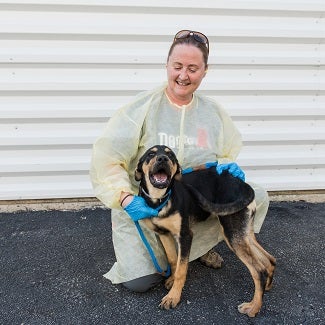
Pictured: Bentley, now grown up, but still with paralyzed back legs.Terri Woodcock, of Wisconsin Retired Breeders Rescue knows exactly where those puppies in pet shops come from. Several years ago she called up Puppy Haven and asked what they did with dogs who couldn’t breed anymore. Wallace Havens said Terri could take his castoff dogs for a flat fee of $50 apiece. In the past several years, Havens has called Terri every few months to say he has some dogs for her—usually six to twelve. These are the ones with congenital defects, sick moms and puppies, some can’t breed anymore, some are puppies the pet stores won’t take.
That’s how Terri took in a Labradoodle who needed $2300 in vet care to repair her ectopic ureters (she constantly dribbled urine before surgery), a Lhasa/Shih Tzu puppy named Bentley who had paralyzed back legs, and even puppies so riddled with bacteria and disease that they died soon after Terri got them to her vet.
Click Here to read about the dogs Terri had rescued dogs from Puppy Haven.Puppy Haven now has an area where people can come in and pick out puppies—straight from breeder to customer. This is the only area of the kennel that Terri has seen, and she said that, at least that section is not the horrific puppy mill scene that many are. But it is also set up just for visitors. Terri said, “It’s just a huge operation where the dogs are treated like cattle. They don’t get any socialization.”
Less Than 3 Minutes a DayIf Puppy Haven has 14 employees to care for 1600 dogs, that means that even if they all worked full time (though they don’t—some are part time), each would be in charge of 114 dogs every day. Calculate out that in a forty hour work week, those employees are working a total of 560 hours (which they aren’t since some are part time). That means that each day, in order to care for 1600 dogs, employees can spend three minutes on each dog.
That’s also assuming that every minute of the eight-hour work day is spent directly caring for the dogs—no answering phones, no lunch or bathroom breaks, no stopping for anything. Is less than three minutes a day enough time to spend on a dog?
Obviously not.
Pet Store Puppies from “Good Breeders?”Click on the links below to see inspection reports from the USDA, courtesy of
www.petshoppuppies.com. Violations are cited in red. Remember that Puppy Haven is still going strong, breeding and selling to pet shops at this very moment.
Report from July 13, 2004
Report from April 25, 2003
Report from August 7, 2002
Report from February 20, 2002
Report from May 3, 2001
Report from October 21, 1999In August, 2006, Havens was suspended from the American Kennel Club for 10 years (the harshest penalty they can hand down) and fined $2000 for “Violation of AKC’s record keeping and dog identification requirements, and non-compliance with the AKC’s Care and Conditions Policy (unacceptable conditions, dog and/or facility).”
As one of the largest breeders in the country, Puppy Haven supplies many pet stores with puppies, including:
PetlandPuppy ParadiseNoah’s Ark Pet CenterThese are only a few of the stores selling Puppy Haven dogs.
What to do with this information?1. Never buy a puppy from a store, online or any place where you can’t see both of the puppy’s parents and where they were raised. Better yet,
adopt pets instead of buying! Millions of healthy pets are euthanized every year (many are purebred and/or young). Check
www.petfinder.org for hundreds of pets in your area who are looking for homes.
2. Support legislation to regulate commercial pet breeding (check
www.network.bestfriends.org/truth) often for the most current information.
3. Tell everyone you know to never buy puppies from a pet shop, and to use extreme caution if buying a pet from a breeder. Remember that it is easy to misrepresent conditions in photos. Never buy a pet if you can’t see both parents and where they were raised.

---------------------------------------------------------------------------------------
Main Photo: Bentley, the dog with paralyzed back legs, as a puppyThanks to:Wisconsin Puppy Mill Project, a group dedicated to ending puppy mills in Wisconsin for fueling the news story and bringing the situation to the public.
Terri Woodcock at Wisconsin Retired Breeders Rescue for her work, input and all the pictures used in this article.
Pet Shop Puppies.com for providing inspection reports information about the Pet Stores that Puppy Haven sells to.
Mike Fry at Animal Ark Shelter for his mathematical skills and assistance with calculations.